
Scientific Study of Soup Production Using Polymer Bag Technology

Abstract
This paper presents a comprehensive technological approach to broth and soup production utilizing advanced polymer packaging techniques. The methodology encompasses thermal processing in sealed polymeric bags under precisely controlled temperature conditions, representing a significant departure from conventional open-kettle cooking methods. This approach demonstrates enhanced yield, improved organoleptic properties, and superior energy efficiency compared to traditional boiling techniques.
1. Introduction
The production of high-quality broths and soups presents fundamental challenges in food service operations. The quality of broth—constituting approximately 90% of a soup's sensory profile—determines the ultimate organoleptic characteristics of the finished product. This paper explores a paradigm shift in broth production methodology: the application of hermetically sealed polymer bags as cooking vessels. This technique, derived from sous-vide principles, offers substantial advantages over conventional thermal processing methods.
The primary rationale for this technological approach stems from the declining quality of available raw bone materials. Modern industrial bone products exhibit significantly lower collagen content and reduced meat residues compared to historical standards. Consequently, conventional boiling methods yield broths with diminished flavor profiles and suboptimal extractive yields. The sealed-bag method addresses these limitations through retention of volatile aromatic compounds and prevention of evaporative concentration, effectively doubling the usable volume of broth compared to open-boiling techniques.
2. Materials and Equipment Specifications
2.1 Packaging Materials
Three distinct polymer packaging systems are employed in this methodology:
Packaging Type | Specification | Application | Temperature Rating | Cost Efficiency |
LDPE (Low-Density Polyethylene) Sleeves | ≥150 μm thickness | Large-volume broth production | 80-100°C | High |
Vacuum Pouches (40×40 cm) | Multi-layer construction | Freeze-thaw applications | -40°C to +100°C | Moderate |
Vacuum Pouches (30×40 cm) | Multi-layer construction | Portion packaging | -40°C to +100°C | Moderate |
The selection criteria for packaging materials encompass thermal stability (maintaining structural integrity at 80-100°C), oxygen barrier properties essential for extended storage, and food-grade certification. LDPE sleeves of 150+ micron thickness demonstrate sufficient mechanical durability for large-scale thermal processing while remaining economically viable for commercial applications. Vacuum pouches from commercial suppliers offer standardized dimensions suitable for portion-controlled broth packaging.
2.2 Thermal Processing Equipment
The methodology employs multiple thermal processing modalities:
Equipment Type | Heating Method | Energy Consumption | Capacity | Application |
Sous-Vide Thermostats (e.g., Sirman Softcooker Y-09) | Immersion circulation | 3.5 kW/hour at 80°C | 50-100 L | Primary production |
Combination Ovens (Rational-type) | Steam/convection | 10-15 kW/hour | Variable | Extended overnight cycles |
Steamers | Direct steam | 8-12 kW/hour | 20-40 L | Small-scale production |
Deep-Fryer Conversion Units (Ponchik-type) | Oil-bath modification | 5-8 kW/hour | 5-10 L | Meatball production |
The sous-vide thermostat configuration (referred to colloquially as "cheburoshka" units) demonstrates superior energy efficiency—approximately one-tenth the operational cost of combi-oven systems—while maintaining precise temperature control within ±0.5°C. One dual-unit configuration can process 100 liters of broth within 4 hours at 80°C, extending to 150 liters during overnight processing cycles.
2.3 Impulse Sealing Systems
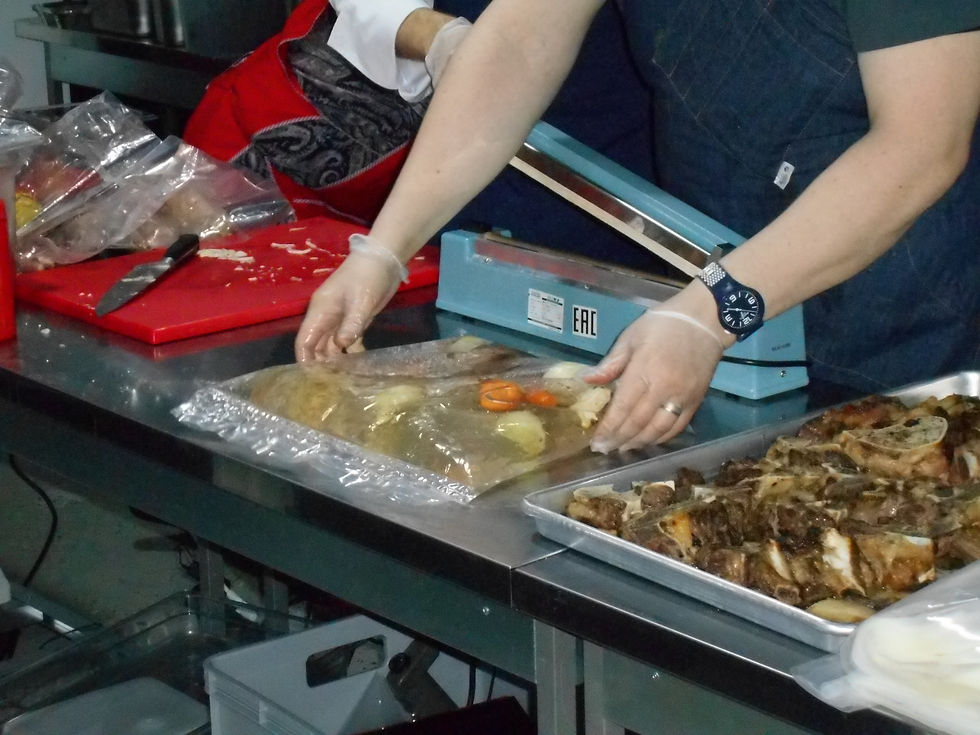
Critical to the success of this technology is the integrity of the hermetic seal. Impulse sealers are specified for closure operations, with a minimum of three parallel weld seams recommended for thermal stability during high-temperature processing. Manual closure using standardized clips presents an alternative method for LDPE sleeves, though with reduced reliability compared to thermal welding.
3. Broth Classification and Composition
3.1 Culinary Classification
Broths are classified into two primary categories based on their intended utilization:
Type | Definition | Application | Quality Criteria |
Culinary Broth | Primary stock for direct consumption | Hot service, display lines | Maximum organoleptic quality |
Technical Broth | Support liquid for regeneration | Reheating starch-containing products, sauce development | Functional performance |
Technical broths serve as moisture transfer media for regenerating starch-based components (rice, potatoes, pasta, udon noodles) and as the aqueous phase for sauce-based dish regeneration. The functional requirements for technical broths prioritize moisture retention and flavor transfer over direct sensory appeal.
3.2 Color Classification
Broths are categorized according to their color profile, determined by the degree of Maillard reaction applied to raw ingredients:
Type | Key Treatment | Ingredients | Flavor Profile |
White Broth | Minimal processing | Raw bones, raw vegetables | Delicate, neutral |
Yellow Broth | Light roasting | Bones and vegetables | Medium intensity |
Red/Brown Broth | High-temperature roasting | Bones, vegetables, or both | Robust, complex |
This methodology predominantly employs brown broth production, as the caramelization of proteins and carbohydrates generates maximum flavor complexity while minimizing the need for added flavor enhancers.
4. Ingredient Preparation Protocol
4.1 Primary Raw Materials
Standardized formulations for 10-liter batch production:
Poultry Broth:
Ingredient | Quantity (g/10 L) | Preparation |
Filtered water | 10,000 | Pre-filtered |
Chicken backs/bones | 2,000 | No washing (brown broth) |
Celery root | 500 | Peeled, coarse cut |
Carrots | 500 | Peeled, coarse cut |
Onions | 500 | Peeled, quartered |
Beef Broth:
Ingredient | Quantity (g/10 L) | Preparation |
Filtered water | 10,000 | Pre-filtered |
Beef bones | 2,000 | No washing (brown broth) |
Celery root | 500 | Peeled, coarse cut |
Carrots | 500 | Peeled, coarse cut |
Onions | 500 | Peeled, quartered |
Smoked Pork Broth:
Ingredient | Quantity (g/10 L) | Preparation |
Filtered water | 10,000 | Pre-filtered |
Smoked pork ribs | 2,000 | No washing |
Celery root | 500 | Peeled, coarse cut |
Carrots | 500 | Peeled, coarse cut |
Onions | 500 | Peeled, quartered |
Fish Broth:
Ingredient | Quantity (g/10 L) | Preparation |
Filtered water | 10,000 | Pre-filtered |
Fish heads, bellies, tails | 2,000 | No washing |
Celery root | 500 | Peeled, coarse cut |
Carrots | 500 | Peeled, coarse cut |
Onions | 500 | Peeled, quartered |
4.2 Vegetable Preparation
The mirepoix preparation incorporates a critical roasting step. Vegetables are wrapped in aluminum foil and subjected to high-temperature roasting at 200°C for 20 minutes in convection mode. This methodology accomplishes two objectives:
Moisture Retention: Sealing the vegetables in foil prevents moisture loss during caramelization, preserving cellular integrity while developing the Maillard reaction products (MRPs).
Maillard Reaction Initiation: The high-temperature environment (200°C) triggers the condensation reaction between reducing sugars and amino acids, generating characteristic flavor compounds including furans, pyrazines, and pyrroles. This reaction is essential for developing the complex flavor profile associated with high-quality brown broths.
The resulting caramelized vegetables exhibit a dark-golden to mahogany coloration, indicating optimal Maillard reaction progression while maintaining structural integrity for subsequent extraction.
5. Bag-Packing Broth Production Protocol
5.1 Critical Preliminary Requirements
Water Quality: Strict adherence to filtration protocols is imperative. Unfiltered water introduces mineral contaminants that can interfere with protein extraction and contribute off-flavors. For facilities lacking in-line filtration systems, manual filtration using activated carbon cartridges or reverse osmosis systems is mandatory.
Raw Material Handling: For brown broth production, raw materials (bones, vegetable components) must NOT be washed prior to roasting. Surface proteins and residual blood components contribute essential flavor precursors that are lost during washing. This practice deliberately preserves surface materials that would otherwise be removed through rinsing.
5.2 Sequential Production Protocol
Phase 1: Packaging Preparation
Configure polymer vacuum pouch by folding the open edges three times (creating a three-fold seal-reinforcement zone).
Place roasted vegetables and raw bones into the pouch.
Fill the pouch with pre-filtered water according to batch specifications.
Seal the pouch using an impulse sealer, applying a minimum of three parallel weld seams. Manual sealing via clips presents an alternative but yields reduced seal integrity.
Phase 2: Integrity Validation
Test hermetic seal by applying moderate pressure. Any gas leakage indicates compromised sealing requiring immediate re-welding.
Phase 3: Thermal Processing
Place sealed pouches into the thermostat bath ("cheburoshka").
Fill the bath with water to provide uniform heat transfer.
Set thermostat temperature to 80°C.
Process for 6 hours.
Phase 4: Post-Processing Cooling
Terminate heating and allow natural cooling.
Strain the broth through appropriate filtration media.
Transfer to storage containers.
Phase 5: Controlled Cooling
Place packaged broth into a blast chiller at -18°C for 90 minutes (frozen storage protocol), OR:
Cool to +3°C over 120 minutes (refrigerated storage protocol).
Transfer to temperature-controlled storage.
5.3 Temperature Rationale
The operating temperature of 80°C represents an optimal balance in the following parameters:
Parameter | Consideration |
Gelatin Extraction | 80°C provides sufficient thermal energy for collagen hydrolysis while avoiding excessive protein denaturation that impedes extraction |
Flavor Retention | Minimizes volatile compound loss compared to 100°C boiling |
Energy Efficiency | Lowers electrical consumption compared to high-temperature processes |
Microbiological Safety | Maintains thermal death kinetics adequate to inactivate vegetative pathogens |
Seal Integrity | Prevents polymer degradation observed at temperatures exceeding 90°C |


6. Scientific Rationale for Enhanced Yield
6.1 Evaporation Prevention
The sealed-pouch system prevents evaporative water loss throughout the 6-hour processing cycle. In open-kettle boiling, evaporative loss typically reaches 40-50% of initial water volume over the same duration. The polymer bag methodology consequently yields approximately double the usable broth volume compared to conventional techniques.
6.2 Volatile Retention
Flavor volatiles—including sulfur-containing compounds (dimethyl sulfide, methanethiol), aldehydes, and ketones—are retained within the sealed environment. These compounds represent the primary sensory contributors to broth flavor and are typically lost to the atmosphere during open boiling.
6.3 Forced Extraction
The sealed system maintains hydrostatic pressure, forcing aqueous extraction of intracellular components from bone matrix and vegetable tissue. This process results in higher concentrations of extractive nitrogen compounds contributing to umami perception.
7. Post-Processing Storage and Stability
7.1 Critical Quality Control Points
Seal Integrity: Contamination of seal areas with broth significantly compromises weld strength. Any seal area contamination leads to compromised weld integrity, creating entry points for oxygen and microbial contaminants, resulting in reduced shelf life (typically <24 hours).
Filtration: Broth clarification is achieved through natural sedimentation rather than traditional clarification techniques involving meat protein or egg whites. This decision is economically driven, as clarification additives substantially increase production costs while providing minimal quality improvement for most commercial applications.
7.2 Shelf Life Specifications
Storage Method | Temperature | Duration |
Refrigerated | +3°C to +4°C | 7-8 days |
Frozen | -18°C | 3 months (minimum) |
8. Meatball Production as a Complementary
Technology
8.1 Methodology
This section introduces an alternative soup production approach utilizing deep-fryer-type equipment (referred to as "ponchik-type" or donut fryer apparatus) for simultaneous meatball preparation and broth production.
8.2 Equipment Modification
The deep-fryer is repurposed by replacing frying oil with water, creating a water-based thermal processing unit. This modification enables:
Controlled temperature operation at 120°C
Continuous processing capability
Dual-stream production (meatballs and broth)
8.3 Operational Protocol
Load minced meat (5 kg) into the dosed dispenser.
Fill the bath with municipal water.
Set processing temperature to 120°C.
Dispense meatballs (operating in "meatball" mode or "chicken ball" mode).
Retrieve processed meatballs using a slotted spoon after processing 50 units (approximately 3-4 minutes).
Drain accumulated broth after each 5 kg of processed meat.
Strain, cool, and package broth for frozen storage.
8.4 Advantages of the Meatball-Based Approach
Aspect | Benefit |
Time Efficiency | Simultaneous protein and broth production |
Flavor Profile | Meat-derived broth (vs. collagen-centric conventional broth) |
Product Differentiation | Positioning for premium pricing (+25% margin potential) |
Quality Differentiation | Authentically handmade product designation |
9. Cream Soup Production
9.1 Production Process
Introduce water into the skillet (10 L water : 1 kg minced meat ratio).
Process for 15 minutes at determined temperature.
Homogenize using high-shear blending (Robot Coupe Ultra type equipment).
Package for frozen storage at -18°C.
9.2 Component Integration
Following the initial homogenization, the following ingredients are incorporated:
Butter (for mouthfeel enhancement)
Potatoes or cauliflower (depending on dietary profile: standard vs. low-carb)
Fillings (mushrooms, pumpkin, others)
Milk (6%) or cream
Fine chop of selected topping material
The complete mixture undergoes secondary homogenization, followed by portioning into cups and subsequent freezing.
10. Soup Base Innovation
10.1 Paradigm Shift in Soup Preparation
Traditional soup preparation methodology relies heavily on bone collagen extraction (gelatin-rich, collagen-dominant broths). While generating acceptable mouthfeel, these broths demonstrate suboptimal organoleptic qualities. The proposed innovation addresses this limitation through meat-based broth production.
10.2 Flavor Profile Enhancement
The "Kvarkini" apparatus (Atesy brand) provides a specialized processing platform enabling concentration of meat-derived flavor compounds. This approach yields:
Meat-derived flavor profiles (rather than connective tissue-derived profiles)
Reduced collagen extraction time
Enhanced organoleptic characteristics (umami intensity, complexity, persistence)
10.3 Premium Product Portfolio
The proposed product line emphasizes handcrafted, differentiated soup products:
Soup Type | Primary Protein Component | Positioning |
Mixed Meat Soljanka | Turkey meatballs | Premium |
Borscht | Meat dumplings | Premium |
Rassolnik | Meat meatballs | Premium |
Fish Soup (Tom Yam style) | Fish balls | Premium |
Chicken Noodle | Chicken balls | Premium |
Lentil Soup | Smoked meats, pork meatballs | Premium |
11. Summary and Conclusions
This paper presents a comprehensive methodology for broth and soup production utilizing polymer bag thermal processing. The key findings include:
Production Yield: Sealed-pouch processing doubles usable broth volume (approx. 100% yield increase) compared to open-kettle boiling.
Energy Efficiency: Submersion thermostat systems consume approximately one-tenth the energy of combi-oven equivalents.
Flavor Quality: Maillard reaction application to vegetables creates complex flavor profiles independent of bone quality.
Production Efficiency: Dual-purpose equipment (meatball production and broth production) maximizes capital investment utility.
Product Differentiation: Handmade product positioning enables premium pricing strategies (up to 25% margin increase).
Storage Stability: Refrigerated storage (7-8 days) and frozen storage (3 months) are achievable.
References
Maillard, L.C. (1912). Action des acides aminés sur les sucres. Comptes Rendus de l'Académie des Sciences, 154, 66-68.
Mottram, D.S. (1998). Flavour formation in meat and meat products: a review. Food Chemistry, 62(4), 415-424.
Roldán, M., et al. (2013). Volatile compound profile of sous-vide cooked lamb. Meat Science, 93(4), 842-849.
Baldwin, D.E. (2012). Sous vide cooking: A review. International Journal of Gastronomy and Food Science, 1(1), 15-30.
Schellekens, M. (1996). New research issues in sous-vide cooking. Trends in Food Science & Technology, 7(8), 256-262.
Farkas, J. (1997). Physical methods of food preservation. In: Food Microbiology: Fundamentals and Frontiers, ASM Press.
Belitz, H.-D., Grosch, W., & Schieberle, P. (2009). Food Chemistry. 4th ed. Springer.
Ternes, W., & Götze, M. (2003). Flavour of cooked vegetables and vegetable products. Flavour Science, 11, 47-52.


Comments